
Where Floyd County's Blotter Lives
Floyd County's sheriff's office publishes no fixed 72-hour or seven-day arrest log on its site. The working blotter lives in local news archives instead. Outlets there post dated items built on Floyd County Jail records. Coosa Valley News arrest reports frequently attach or link a Sheriff media PDF. The WRGA Floyd County archive runs text reports with pages of history behind them. You can search both backward across many dates. That suits a weekend review or a prior-week search far better than a present-custody question. Neither outlet promises a set posting hour, though both publish daily or close to it. Keep in mind that dates can mislead here. An article date can diverge from the arrest date. Actual custody status can diverge too.
The Coosa Valley multi-day arrest archive displays its dated category layout for stepping between reports.
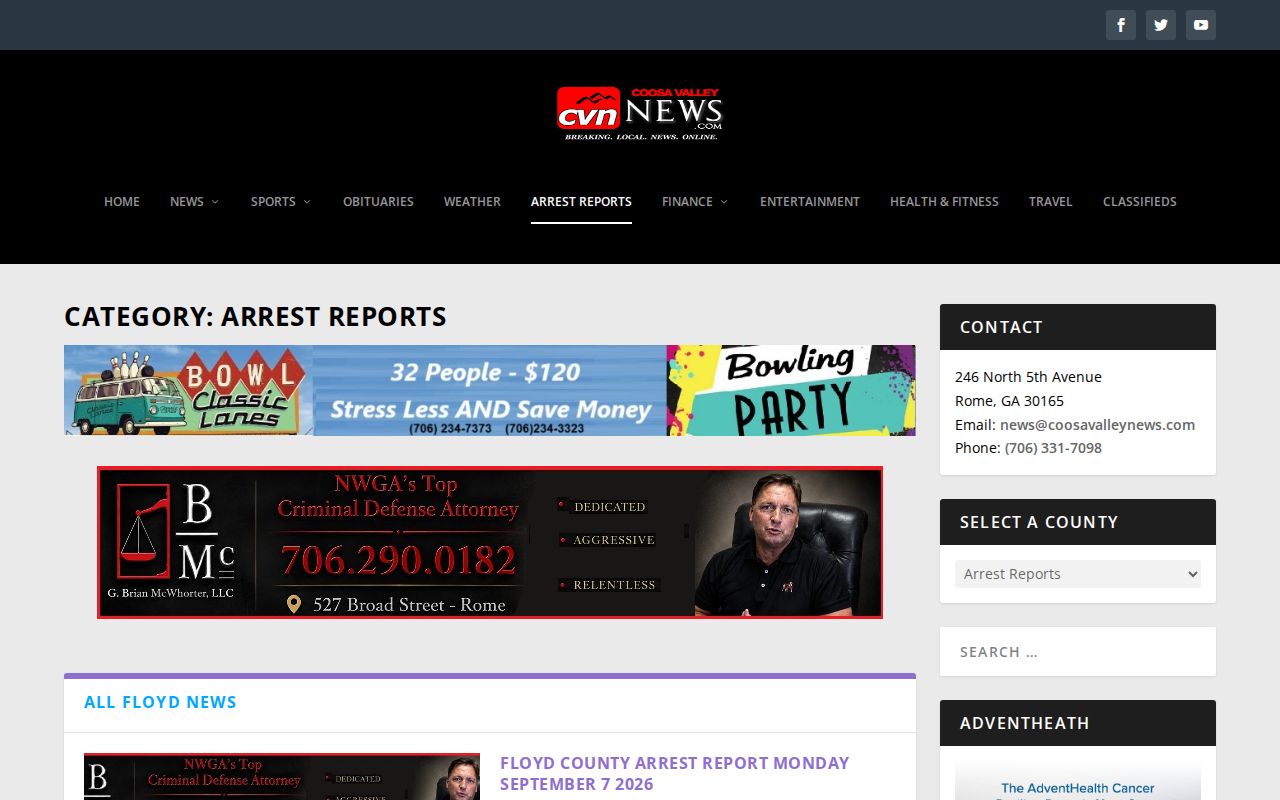
This is a secondary archive view, not the agency's own system.
Reading Floyd Arrest Reports by Date
Start with the publication date. Then work back toward the actual arrest date. A news headline makes a handy index, but it is not the original Floyd County record.
- Start with Coosa Valley or WRGA and open the newest relevant dated post. For a weekend, inspect the first business-day post plus the prior Friday.
- Read the item's source attribution and note whether it links a Sheriff media PDF or summarizes jail records in text.
- Compare the arrest date, agency, location, and charge details. Do not treat the post date as an exact intake timestamp.
- Check the official FCSO Current Inmates roster only if present custody matters. A released person may no longer appear there.
- Use the County's NextRequest portal for a date-bounded official booking record beyond what the archive supplies.
Need a booking from today? The Arrests Last 24 Hours page fits that job. This blotter workflow serves a different purpose. It covers several publication dates, catch-up posts, and arrests already past the one-day mark.
What Floyd Blotter Entries May Show
Entries look different depending on format, since this multi-day layer mixes text articles with linked PDFs. If a field is blank or a photo is missing, leave it blank.
| Entry element | How to interpret it |
|---|---|
| Name and age | Identity details selected by the article or carried from the report; verify a common-name match. |
| Arrest date or locality | The event date or place when published, which can differ from the article's date. |
| Agency | FCSO, Rome Police, Georgia State Patrol, or another agency booking into Floyd County Jail. |
| Charge | The charge recorded at booking, sometimes with statute language. It is not the court disposition. |
| Source attribution | Often Floyd County Jail records or a linked Sheriff media report. |
| Photo | Coosa Valley's linked Sheriff PDFs may include photos; the text-first radio and WRGA presentations do not consistently do so. |
A Sheriff PDF sometimes adds more detail. It can list the arresting officer, the arrest location, a release reason, race, sex, and address. You may also see a "Cleared by Arrest" notation. That phrase just ties a reported offense to an arrest in the paperwork.
Floyd County Arrest News Layers
Beyond the official sources, several Floyd outlets add a searchable date layer on top. WRGA often posts "Arrest reports for [date]" in plain text. It sometimes folds a whole weekend into one item. WROM/103.1 Radio M, Q102.3, and MyK Country also run date-specific text reports. Those reports are credited to Floyd County Jail records. Coosa Valley stands apart. Its posts often route readers to Sheriff media PDFs that carry booking photos. The Coosa Valley Floyd County category blends wider local coverage with dated report material.
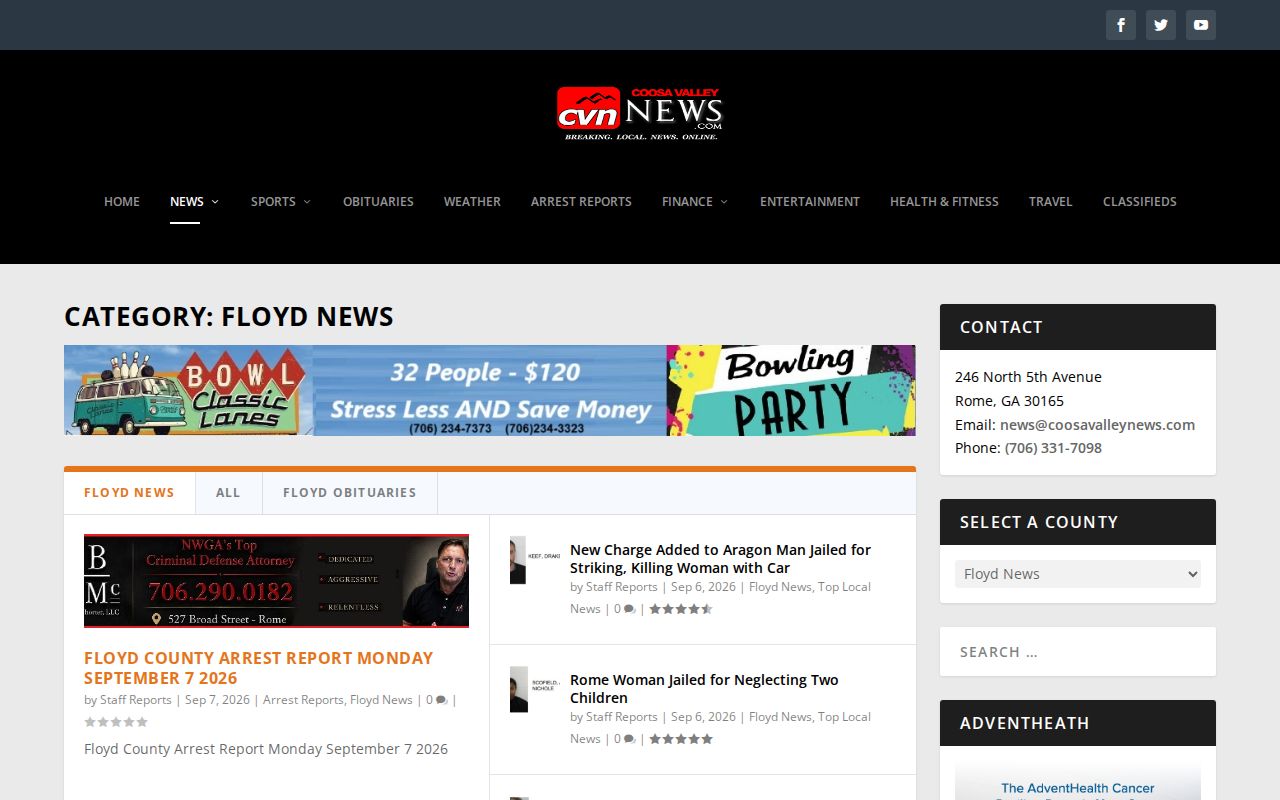
That broader category adds context. It is not a full agency blotter, though. Every outlet here is a secondary publisher. Articles can be incomplete, hold stale details after a release, or skip a correction. They also cover the whole county jail, mixing Rome, Cave Spring, Lindale, Shannon, and unincorporated areas. A county article alone cannot place each arrest in one city.
Older Floyd Arrest Records and Retention
Floyd County's older Sheriff-provided daily-report archive reaches back to at least 2012 through year links. File availability, host stability, and photo access vary by year. A news article may survive long after it leaves page one. Another post may vanish. None of that reflects the government's retention duty. Georgia's Archives schedule for local governments sets the periods. Incarceration lists are kept for one year. Jail booking records last ten years after release, and jail registers run ten years past the last entry. Inmate case files also last ten years after release. Those are agency retention categories, nothing more. FCSO does not promise to keep a report publicly searchable that long. An old third-party copy is not current either. Ask the record custodian first for older material. Give FCSO the person's name, date of birth if known, the arrest date or a tight range, the arresting agency, and the exact record type. If the Sheriff does not hold the incident report, try the arresting city or state agency. The Georgia Archives retention schedule helps identify record classes, but it is no substitute for a modern booking search. Note: Restriction or sealing can change access without shortening the retention period for the underlying government record.
Unofficial Booking Archives
Commercial county pages like Busted Newspaper Floyd County and RecentlyBooked Floyd County offer date navigation. That helps once official and local-news checks come up empty. Neither is a government record. Both can lag. Both may keep a page alive after release, dismissal, correction, or restriction. Treat neither as proof of current custody. The Busted Newspaper county section shows the typical unofficial photo-and-date layout.
Unofficial archives fill gaps, but they rank below the source. RecentlyBooked presents a rolling 30-day window of arrests with daily refreshes. That is the publisher's own claim, though. Mugshots.com works more like a deep historical archive. Georgia Arrests instead carries a batch of older indexed dates. Mugshots.zone lists no Floyd County section at all. For any booking question, official FCSO records and the court disposition outrank every aggregator.
From Arrest Entry to Court Outcome
A blotter freezes a moment early in a case. Charges can shift or vanish afterward. For a Floyd County arrest record, the current roster answers who is in custody, the booking report covers intake, and the Clerk's case file tracks what the court later did. Treat each as its own answer rather than one conclusion.
Stay anchored to the exact public document. A blotter entry serves one purpose, and copying booking photos into a gallery serves none. When a news page or commercial site contradicts an official Floyd County record, ask the originating custodian for a correction. The court alone settles how the case ends.